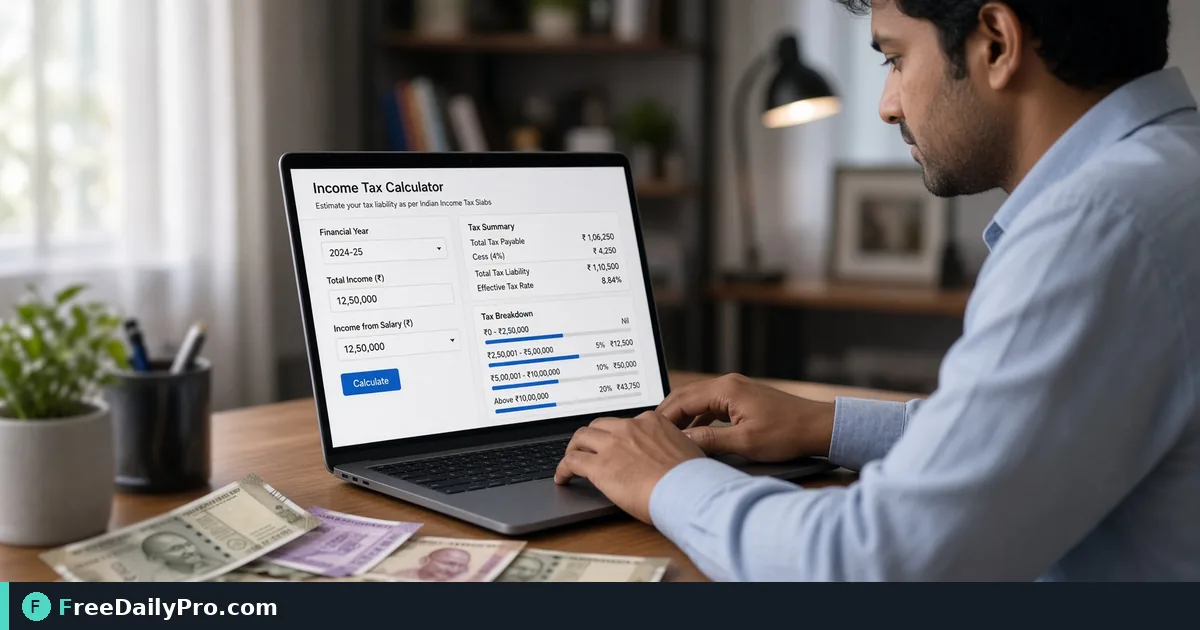
Compare Old and New India Tax Regimes Before You Accept an Offer
Worked FY 2026-27 examples for Rs 12, 14 and 18 lakh salaries with the old and new regimes, rebate, cess and the deduction break-even point.
An offer letter says ₹18 lakh a year, and the first question is what lands in your account after tax. In India that depends on a choice many people make once and never revisit: the old regime with deductions or the new one with lower rates. India Income Tax works out both at once, so the answer is on the screen in a minute rather than in a spreadsheet you rebuild every April.
The clip below compares the two regimes in the tool.

What goes into the form
The calculator uses FY 2026-27 slabs for individuals, which it states are unchanged from the previous year after Union Budget 2026. It asks for five things: annual gross salary, other income (interest, rent or freelance receipts, which get no standard deduction), deductions for the old regime only (80C, 80D, HRA and the like), employer NPS contribution under 80CCD(2), and an age group. Age matters only for the old regime, where the basic exemption rises for seniors.
It then shows tax for both regimes, the monthly equivalent, a highlighted Recommended regime with the saving, and a collapsible slab-by-slab working for each. The standard deduction is applied for you: ₹75,000 in the new regime and ₹50,000 in the old. Surcharge for high incomes and 4 percent cess are included. All of it is computed in your browser.
Example 1: a ₹12 lakh salary
Enter 12,00,000 as salary, 1,50,000 as old-regime deductions, and leave the rest at zero. In the new regime, taxable income is 12,00,000 minus the 75,000 standard deduction, which is 11,25,000. Slab tax is ₹52,500, but the Section 87A rebate of up to ₹60,000 wipes it out, so the tax is ₹0.
In the old regime the same person has taxable income of 10,00,000 after the 50,000 standard deduction and 1,50,000 of deductions. Slab tax is 5 percent on 2.5 to 5 lakh (₹12,500) plus 20 percent on 5 to 10 lakh (₹1,00,000), a total of ₹1,12,500, and with cess ₹1,17,000, or ₹9,750 a month. The tool recommends the new regime here, saving ₹1,17,000.
Example 2: an ₹18 lakh offer
At 18,00,000 the new regime gives taxable income of 17,25,000. The slab working is ₹20,000 on 4 to 8 lakh at 5 percent, ₹40,000 on 8 to 12 lakh at 10 percent, ₹60,000 on 12 to 16 lakh at 15 percent, and ₹25,000 on the last 1,25,000 at 20 percent, a total of ₹1,45,000. Add 4 percent cess and the tax is ₹1,50,800, about ₹12,567 a month.
Under the old regime with ₹1.5 lakh of deductions, taxable income is 16,00,000 and tax with cess comes to ₹3,04,200. That is roughly ₹1.53 lakh more than the new regime, so deductions at that level do not rescue the old regime.
How large must deductions be? Raise the old-regime deduction field and watch the recommendation flip. For this salary the break-even is about ₹6.4 lakh of deductions. At ₹4 lakh the old regime costs ₹2,26,200; at ₹5 lakh ₹1,95,000; at ₹6 lakh ₹1,63,800; against ₹1,50,800 in the new regime. Few salaried people can legitimately claim 6.4 lakh, so check what you actually have before assuming the old regime wins.
Example 3: what a raise really nets
Say you earn ₹14 lakh now and the new job pays ₹18 lakh. In the new regime, tax at 14 lakh is ₹81,900 and at 18 lakh ₹1,50,800. The extra ₹4,00,000 of gross brings ₹68,900 more tax, so ₹3,31,100 stays with you, about 83 percent. Percentage Calculator is handy for turning offer versus current pay into a percentage hike. Remember that PF and other payroll items, not covered here, reduce take-home further.
The 12 to 13.5 lakh band
Just above the rebate limit, the new regime applies marginal relief so that tax cannot exceed the income above the limit. At ₹12.75 lakh salary the tax is ₹0. At ₹13 lakh it is ₹26,000, and by about ₹13.5 lakh the relief has run out and tax follows the slabs, which is ₹74,100 at ₹13.5 lakh. If you are negotiating around those figures, test several salaries, because a ₹25,000 rise from ₹12.75 lakh to ₹13 lakh adds ₹26,000 of tax. This is the one place where a small change in pay has a large effect.
Using the employer NPS field
An employer contribution to NPS under 80CCD(2) is allowed in both regimes, capped by the tool at 14 percent of salary in the new regime and 10 percent in the old, treating your salary as basic pay. At ₹18 lakh, an employer NPS contribution of ₹1 lakh lowers new-regime tax from ₹1,50,800 to ₹1,30,000, saving ₹20,800. Because the cap is worked out on the whole salary, it can overstate the limit if your real basic pay is lower. Confirm the figure with your payroll team.
Step by step
- Enter the annual gross salary from the offer letter, not the monthly amount.
- Put interest, rent or freelance receipts in Other income.
- Enter only deductions you can document under Old Regime deductions. The field starts at ₹1,50,000, so overwrite it if that is not your number.
- Add employer NPS if your offer includes it.
- Choose the age group.
- Read both totals and the Recommended box, then open each working section to see where the tax comes from.
What this estimate leaves out
The tool does not model HRA exemption details, capital gains taxed at special rates, or other special provisions, and it is an estimate rather than tax advice. For filing, rely on the official income tax department portal and a qualified professional. GST on freelance invoices is a separate matter; GST Calculator covers that side. For a comparison with other countries, see US, UK and India tax calculators compared, and the tax calculators category lists more.
Which part of an offer are you trying to price, deductions, bonus or an employer benefit? Tell us on the contact page.