Write an Invention Disclosure Your Patent Attorney Can Use
Fill the nine-field disclosure worksheet with a worked example, add a witness page, and learn what to settle before sharing an idea publicly.
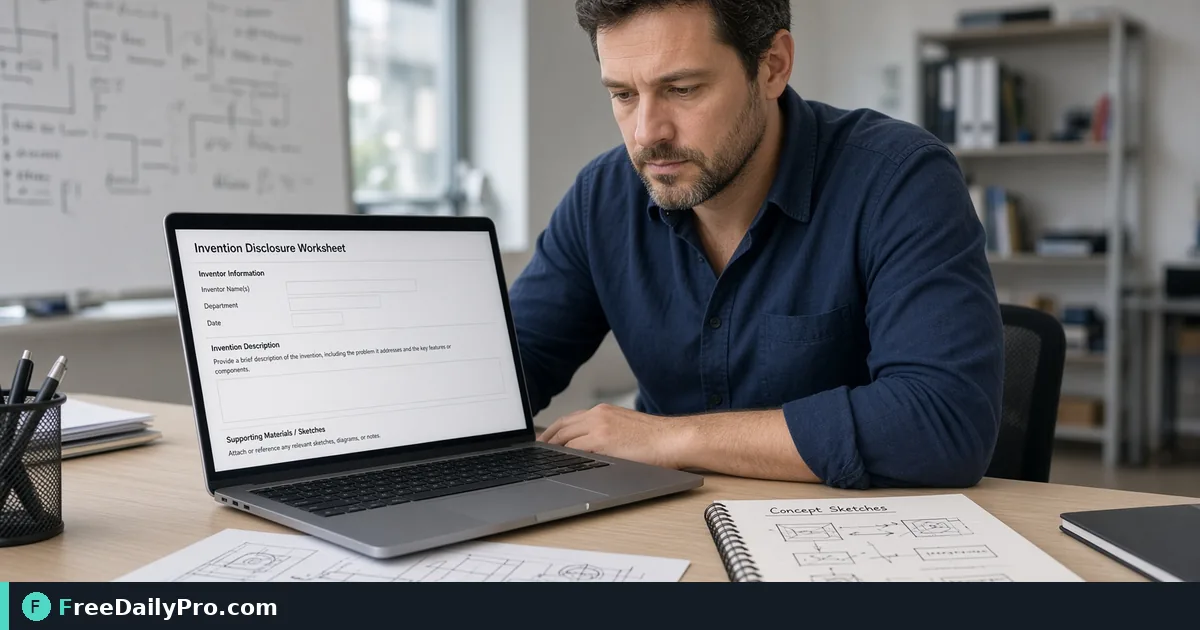
You have been sketching a device in a notebook for three weeks and finally have a prototype that works. The next sensible step is not a launch post. It is a clear written record of what you made, when you thought of it, and how it differs from what exists. Invention Disclosure Worksheet gives that record a structure and prints or saves it as a PDF with signature lines, ready to hand to a patent attorney or keep on file.
The clip below shows the worksheet being filled in.

What this worksheet is, and what it is not
It is an organising document, not a patent application. It does not file anything with any patent office and does not create legal rights by itself. The claims, the formal legal language that defines what is protected, must be drafted by a registered patent attorney or agent, and the tool says so prominently at the top of the page.
The page also carries a warning that matters more than any field: do not publish or sell the invention before you get advice. A post, a talk, a demo, a crowdfunding page or an offer for sale can start a deadline or end your right to a patent in many countries. The page notes that the United States generally has a one-year grace period while many other countries have none. This guide cannot tell you which rules apply to you; that is a question for a qualified professional.
The nine fields, with a worked example
Imagine a developer who has built a water-bottle cap that detects tilt and estimates how much was sipped. Here is what each field might hold.
- Title of Invention. Specific and descriptive: "Bottle cap with tilt-based sip volume estimation".
- Inventor(s). Full legal names of everyone who contributed to the idea itself, not people who only built or funded it.
- Date of Conception. A date picker. Enter the best-supported date, such as the day of the first dated notebook page.
- Field of Invention. A short technology area, for example "wearable and handheld hydration sensors".
- Background. The problem: people forget to drink, and existing smart bottles are expensive and need a special bottle.
- Detailed Description. How it works, in enough detail that a skilled person could rebuild it: sensor type, how tilt angle and duration map to volume, how data reaches a phone, power source, materials.
- Key Novel Features. What you believe is new: fits standard bottle threads, estimates volume without a flow sensor, works for a year on a coin cell.
- Alternative Versions or Embodiments. Variants you have considered: a version for flasks, one that logs by magnet instead of tilt.
- Known Prior Art. Products and patents you already know about, with names and links, and a sentence on how yours differs.
Step by step
- Open the worksheet and read both warning boxes before typing anything.
- Fill the fields in the order shown. The right-hand panel is a live preview of the printed document, so you can watch it take shape.
- Write the Detailed Description in plain sentences. Include dimensions, values, materials and the order of operations. If a step is a guess, say so; a clearly marked unknown is more useful than a confident gap.
- Add the prior art you know, including things that make your idea look less novel. Hiding them helps no one, and your attorney will find them anyway.
- Press Print / Save as PDF. Your browser's print dialog opens; choose Save as PDF as the destination.
- Sign and date the inventor line, and ask a witness to sign and date theirs. Commonly the witness is someone who read and understood the document and is not a named inventor, but confirm the practice with your attorney.
Keep a copy and attach your sketches
The page does not keep what you type once you leave it, so save the PDF before closing the tab. Pictures belong with the record. Photograph the notebook sketches, turn them into a PDF with Image to PDF, and join them to the worksheet with Merge PDF so the description and drawings travel as one file. The text you type is turned into the printable page in your browser.
If you plan to discuss the idea with a collaborator or manufacturer before filing, an NDA signed first is the usual precaution; the worksheet itself recommends sharing only under a signed NDA or with your attorney. NDA Generator builds a draft agreement you can have reviewed.
Writing a description that holds up
Vague text is the most common weakness. Compare "uses a sensor to measure drinking" with "a three-axis accelerometer sampled at 10 times a second; when the cap angle exceeds 100 degrees for more than 0.5 seconds the firmware logs a sip". The second sentence tells a reader what you built. Also separate what you made from what you merely hope to make, since the worksheet records your state of knowledge on its date.
Describe the failures too. Approaches that did not work show how you arrived at the final design and can matter when someone later asks what was actually invented.
Common mistakes
- Treating the worksheet as a filing. It starts nothing at a patent office.
- Posting a video of the prototype before getting advice. This is the very situation the page warns about.
- Listing the boss or financier as an inventor because they paid for it. Inventorship follows contribution to the idea.
- Leaving prior art blank. Even "none known" should come after a real search of products and listings.
- Using today's date as the conception date. Use the date you can support with a record, and note the source.
- Forgetting the signatures. An unsigned, undated printout is a weaker record.
Where to go from here
Bring the printed worksheet and the merged sketches to a registered patent attorney or agent in your country, together with a list of any public disclosures already made. The wider business tools category has contract and document helpers for the steps that follow. This guide is general information and not legal advice.
What stage is your idea at, a first sketch, a working prototype or a product already on sale? Tell us on the contact page.