Resume Builder — Create an ATS-Friendly Resume
Create ATS-friendly resumes from ten templates, reorder sections, add a photo and save your resume as a file
application · 2 trial uses a day · $3 day pass or $9.99 a month
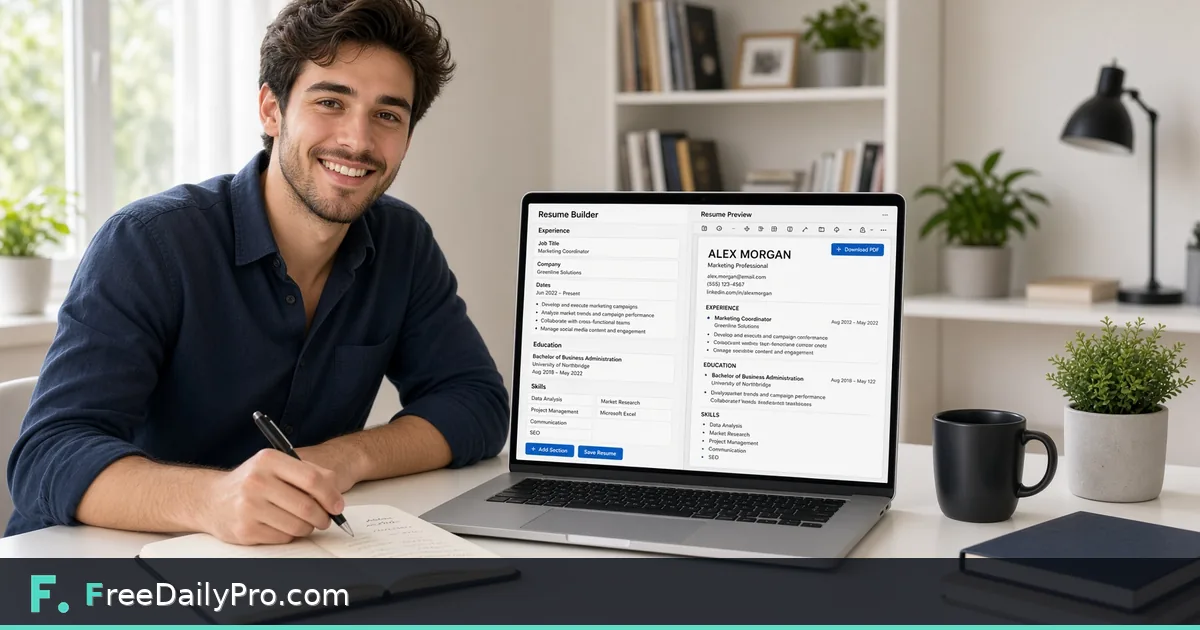
Section by section, to an ATS-friendly resume — not a rigid template fight.
Enter your full name.
Experience
Education *
Degree is required.
School is required.
Section order
Move sections up or down. Sections you leave empty are not printed.
- Summary
- Experience
- Projects
- Education
- Skills
- Certifications
Template
Fill in the highlighted fields above to enable preview and download.
Applying for a specific job? Check your resume against the job ad with the resume keyword matcher.
Watch: Resume Builder in Action
Create ATS-friendly resumes from ten templates, reorder sections, add a photo and save your resume as a file
- What does "ATS-friendly" actually mean here?
- Many companies run resumes through Applicant Tracking Systems that parse the text before a human ever sees it. Complex layouts (multi-column designs, text inside images, decorative graphics) often parse incorrectly or get skipped entirely. This tool's output avoids those specifically so your content reaches a human reviewer intact.
- Can I save my progress and come back later?
- Not currently — everything is held in your browser for the session, nothing is saved server-side. Finish in one sitting, or keep your content drafted elsewhere and paste it in when you're ready to generate the final PDF.
- Is this good for creative fields where a more visual resume is expected?
- Not really its strength — if you're in a field (design, for example) where a highly visual resume is the norm and ATS parsing matters less, a dedicated design tool will serve you better. This tool is built specifically for the common case where ATS compatibility matters more than visual flair.
- What should I do with my resume after building it here?
- Run it through PDF Editor for any final touches, then Compress PDF before sending — a resume that's too large can bounce from an applicant tracking system's upload limit or sit at the bottom of a recruiter's inbox while it loads.
- Why are Preview and Download greyed out?
- Both stay disabled until Full Name is filled and at least one Education entry has both a Degree and a School. That is a rule of this tool, so enter your highest qualification or the course you are taking, even if you would rather keep education brief.
- How do I create bullet points under a job?
- Write one achievement per line in the bullets box for that entry. Blank lines are ignored, and the tool adds the bullet character itself, so do not type your own dash or dot or you will end up with two markers.
- What actually differs between the three templates?
- There are ten templates. Classic centers the name and contact line and uses gray divider rules. Modern left-aligns everything, colors the name and headings teal and adds a teal bar across the top of the PDF. Minimal is left-aligned with uppercase headings, no dividers and slightly smaller text.
- Can I write my resume in a language other than English?
- Accented Latin, Greek, Cyrillic and the rupee sign use an embedded font in the PDF. Other scripts, including Hindi, Chinese and Arabic, are drawn as pictures, so they display correctly but that text cannot be selected or searched in the PDF.
- Should I download the PDF or the Word file?
- Use the PDF when the layout must stay fixed and the employer accepts it. Use the Word file when you want to keep editing or when an application asks for .docx. Both come from the same entries, so after changing the form, download again.
- Can I add a photo or move the sections around?
- Yes. Add a photo if you want one, but many employers prefer none. Use the up and down buttons to reorder Summary, Experience, Projects, Education, Skills and Certifications, and leave out any you do not need.
- Can I save my resume and carry on later?
- Yes. Save resume downloads a small file to your device, and Open resume loads it again. Nothing is stored on our servers, and the form is cleared when you close the tab.
How to use Resume Builder
Start with Full Name, which is required, and a Contact Line such as email, phone, city and a profile link. A Summary is optional. Under Experience, enter Role, Company and Dates for each job, then write the bullet points in the box, one per line; Add Experience creates another entry. Under Education, at least one entry with a Degree and a School is required. Type Skills as a comma-separated line.
Choose a Template: Classic has a centered header with gray divider lines, Modern is left-aligned with a teal accent, and Minimal is compact with no dividers. Press Preview to check the layout. Select US Letter or A4 for the PDF, then press Download PDF or Download Word (.docx). The file name is built from your name and the template.
When to use it
It fits a student or early-career applicant who needs a tidy one-column resume quickly, a person refreshing an old document, or anyone who wants a PDF to upload and a Word file to edit further. A single column of plain text is also easier for screening software to read than an elaborate layout.
When not to use it
Skip it for a creative portfolio or an academic CV that runs many pages with publications and figures; a word processor gives you control this builder does not. It has no columns, charts or skill-rating bars, on purpose, because plain layouts are easier for screening software to read.
Tips for best results
Begin each bullet with an action and end it with a result, one idea per line, because every line becomes its own bullet. Compact fits the most onto a page. Pick the Word file when you want to reword for each job, and the PDF when the layout must not shift. Use the link to the keyword matcher to compare the resume with a job post before you apply, and save the resume file to reuse it next time.
Limitations
There are ten templates and six sections (Summary, Experience, Projects, Education, Skills and Certifications) that you can reorder or leave empty. A photo is optional and placed only in the templates that show one, and some employers prefer none. Dates and years are plain text with no checking, and a long resume continues onto further pages. Entries are not stored on our servers: use Save resume to keep a file on your device and Open resume to continue later. Refreshing the tab clears the form unless you saved the file.
Privacy
Your name, contact line and work history are assembled into the Word or PDF file inside your browser. They are not uploaded and are not kept after you leave the page. If your text includes accented letters or non-Latin scripts, a font file may be fetched from this site to draw them. Only a usage count naming the tool is reported when you download.
How to use this app
- Fill in your contact info, then add sections for experience, education, and skills.
- Preview updates live as you type, so you can see the finished layout before downloading.
- Download as a PDF formatted to parse cleanly through applicant tracking systems (ATS).
Tips
- ATS-friendly means avoiding complex multi-column layouts, text boxes, and graphics that many tracking systems fail to parse correctly — this tool's output is deliberately plain for that reason, not because it couldn't do fancier layouts.
- List experience in reverse-chronological order (most recent first) — it's both the ATS-friendly convention and what most human reviewers expect.
- Keep bullet points under each role focused on outcomes, not just duties — a resume section is one of the few places on the site where content quality matters as much as the tool's formatting.